2026 MACD Annual Conference Agenda
Michigan Conservation: Empowering Communities and Ecosystems
October 20-22, 2026 • Lansing Center • Lansing, Michigan
October 19
Director Training/State Council Lunch and Networking
State Council Meeting
Director Training
State Council Dinner
October 20
Annual Business Meeting and Elections
Session Description
The annual MACD business meeting, including board and officer elections, review of organizational business items, and updates from leadership. District directors and State Council members will help guide the direction of MACD for the coming year.
Annual NRCS District Conservationists' Meeting
Exhibitor/Sponsor Set-up
Open Registration
Conservation District Showcase Luncheon and Conference Welcome
Session Description
Kick off the conference with a celebration of the people and projects making a difference across Michigan. Over lunch, you'll see Conservation Districts' stories come to life through photos, data, and highlights from every region. Mike Edwardson of Plainsong Farm will share the firsthand impact Conservation Districts have had on his farm, and why this work matters. You will also receive a welcome message from statewide leaders including MACD President Jerry Miller, NRCS State Conservationist Diane Gray, and MDARD Director Dr. Tim Boring discussing the future of conservation in MIchigan. Arrive early, find your regional table, and get the conversation started with tabletop questions about the projects, partnerships, and challenges shaping your community. You can look forward to an interactive experience that will set the tone for everything to come over the three days of the conference. Come hungry, and ready to connect.
Director Round Table
From Ripple to Wave: Building a Community Water Festival from the Ground Up
Session Description
What does it take to turn a conservation idea into a community celebration? This session walks through the full journey of developing the Lake City Ripple Effect Festival, a free, family-friendly event in downtown Lake City dedicated to water science, stewardship, and community connection. From identifying partners and recruiting exhibitors to crafting a sponsorship strategy and measuring community impact, attendees will leave with practical tools and inspiration for building events that move conservation education out of the classroom and into the heart of their communities.
Easement Stewardship and Compatible Use Authorizations
Session Description
This session will explore effective easement stewardship and the appropriate use of Compatible Use Authorizations (CUAs) to protect NRCS’s perpetual conservation investment. We will review monitoring procedures and documentation, landowner communication, and CUA guidance to ensure long-term protection of easement purposes and conservation values.
Guardians of the Galaxy: Incorporating Invasive Species into Conservation District Programming
Session Description
Invasive species have been getting a lot of attention these past few years, especially as they impact agricultural, forest product and recreational industries. Education and outreach are vital tools for Conservation Districts, empowering communities with the knowledge on communicating how invasive species intersect those industries, so they can make informed decisions about land, water, and resource stewardship. Having a successful outreach program not only empowers communities, but in turn can yield new partnerships and can strengthen community support for Conservation Districts and the work they do. In this talk we will discuss how to set the stage for invasive species education, the impacts to our land and waters, highlight some species of interest, important tools staff and residents can use to report species, and share strategies on how to incorporate invasive species education into different types of district programming.
Poster and Photo Contest
Renovate or Remove? The Trout River Dam in Presque Isle County
Session Description
The Presque Isle Conservation District owns the 270 acre Herman Vogler Conservation Area partially inside the Rogers City municipal limits. This area is a popular destination for locals and other outdoor enthusiasts. The Trout River runs through this recreation area and features an 87 year old dam and flooding built to form a trout pond by a local sportsmen’s club. While the water in the impoundment is far too warm to support trout, the dam does form a partial critical barrier to the exotic Sea Lamprey breeding habitat. The Dam also blocks native fish species from moving to the upper reaches of the trout river.
While the area is situated on the edge of the city, the land is owned and managed by the Presque Isle Conservation District rather than the city government.
This presentation chronicles the decision to repair, replace or remove the dam and the controversy surrounding the trade off decision to restore the continuity and connectivity and health of this local river watershed.
Farm to Family Listening Session
Session Description
MDARD's Farm to Family Program is focused on strengthening local food supply chains, engaging community input, and embracing innovation. The program offers grants, networking opportunities, and marketing consultations to farmers, food businesses, and other local food supply chain stakeholders across the state. The purpose of this interactive listening session is to identify the emerging needs and opportunities that conservation district staff and other food system stakeholders have identified in their communities. This feedback will directly inform our program's funding and technical assistance priorities in future years. You'll also hear about what we learned on our listening tour in 2025, and how we're already applying it to our work. If you have ideas about what projects our team should be funding, you should attend this session!
State of Agroforestry in Michigan: Where are we at? Where are we going?
Session Description
In this session, a panel of members of the Michigan Agroforestry Working Group will provide an update of agroforestry in Michigan including status of practices, policies, and funding sources. What is adoption looking like? Are districts offering agroforestry practices and knowledge sharing to their community? What is TSP capacity and access across the state? We will seek questions and feedback from attendees as well as input in producing a roadmap and list of priorities for the Michigan Agroforestry Working Group as it moves forward.
Afternoon Snack Break
Urban Forest Walking Tour: Discovering Nature in Downtown Lansing (Field Trip, meet in main concourse)
Session Description
Come experience downtown Lansing from a new perspective and discover the vital role trees play in creating a greener, healthier, and more resilient city.
Join staff from the DNR’s Urban and Community Forestry (UCF) team for a walking tour through the urban forest of downtown Lansing and discover how trees, green spaces, and natural habitats contribute to the health and character of the city. Participants will explore the diverse tree canopy, learn to identify common native and ornamental species, and gain insight into the ecological benefits urban forests provide—including cleaner air, cooler temperatures, stormwater management, and wildlife habitat.
As we walk through parks, streetscapes, and green corridors along the river, we'll discuss the history of Lansing's urban forestry efforts, current sustainability initiatives, and the challenges cities face in maintaining healthy urban ecosystems.
Michigan Green Communities Panel
A Journey in Regenerative Agriculture
Session Description
- Introduction of Buechler Farms LLC
- What farming practices the farm used before the journey started
- What farming practices are utilized today
- How we got there
- Where to go in the future
Profiling successful outreach approaches and capacity among Michigan conservation districts
Session Description
This session will discuss Farm Bill Program Eligibility requirements, including how to determine participant and land eligibility. It will cover common challenges , required documentation, and strategies for resolving issues for program delivery.
Farm Bill Program Eligibility
Session Description
This session will discuss Farm Bill Program Eligibility requirements, including how to determine participant and land eligibility. It will cover common challenges , required documentation, and strategies for resolving issues for program delivery.
Empowering the Next Generation of Conservation Leaders: Student & Professional Networking
Session Description
This interactive session provides a structured networking experience that connects students with conservation professionals. Using a rapid networking format, participants will engage in a series of short one-on-one conversations. Each round will be guided by prompting questions to encourage meaningful dialogue about career pathways, needed skills and experience, strategies for finding conservation career opportunities, and other relevant topics. Students will gain exposure to various career pathways, develop networking skills, and establish new professional connections. Conservation professionals will have the opportunity to directly engage with and help inspire emerging professionals.
Rooted & Ready: The Next Generation of Michigan Farmland
Session Description
Michigan is losing farms and farmland at a pace that should concern every conservation district. As longtime farmers retire and development pressure mounts, the question of who will steward these working lands next has become one of the most urgent emerging issues in conservation. This session zooms out to the bigger picture behind MIFarmLink and the land trusts working alongside it: keeping Michigan's agricultural land in agriculture, in local hands, and resilient for the generation to come. We'll explore where Michigan agriculture is headed, how land access and succession planning tie directly to ecosystem and community health, and what a coordinated, statewide approach to farmland conservation could look like. Drawing on models from other states, including South Dakota and Colorado, we'll see how farm-link programs and land trusts can work hand in hand to protect working lands across Michigan. Attendees will leave with a clearer picture of the road ahead and a real sense of the momentum already building to keep Michigan's farmland farming.
Better Together: Conservation Districts & DNR
Session Description
For years, the Muskegon Conservation District and Kent Conservation District have independently partnered with the Michigan Department of Natural Resources to implement habitat restoration and conservation projects on state game areas. These collaborations have enhanced habitat for game species while restoring and protecting critical habitat for threatened and endangered species, invasive species management, and other DNR conservation priorities.
In this session, presenters from Muskegon and Kent Conservation Districts will share how these partnerships were established, why they have become invaluable to both the Districts and the DNR, and the conservation successes achieved through collaborative project implementation. Attendees will learn practical strategies for building relationships with local DNR staff, identifying shared priorities, developing sustainable funding opportunities, and positioning their Conservation District as a trusted conservation partner. Whether your District is looking to expand programming, diversify funding sources, or increase its impact on public lands, this session will provide actionable steps to help you get started.
Silent Auction and Exhibitor Visit + Empowering the Next Generation of Conservation Leaders: Student & Professional Networking
Session Description
This interactive session provides a structured networking experience that connects students with conservation professionals. Using a rapid networking format, participants will engage in a series of short one-on-one conversations. Each round will be guided by prompting questions to encourage meaningful dialogue about career pathways, needed skills and experience, strategies for finding conservation career opportunities, and other relevant topics. Students will gain exposure to various career pathways, develop networking skills, and establish new professional connections. Conservation professionals will have the opportunity to directly engage with and help inspire emerging professionals.
Director ONLY Euchre Night
October 21
Yoga
Breakfast
From Access to Action: Engaging Underinvested Communities in Conservation and Sustainability
Session Description
This session focuses on practical strategies for engaging historically underserved communities and building meaningful partnerships that advance conservation efforts.
Cultivating Change: How Replacing Banned Species Can Heal Your Backyard
Session Description
Now that MDARD has officially banned six plant species from the trade, how can we cultivate change in our landscapes to be healthier? We know what these invasive plants have done/can do to habitats of Michigan, but for others, they don’t understand. We need to assist the public with good alternatives that will provide valuable resources for the fauna in Michigan that depend on native plants. We as human beings must become the stewards of our landscapes. In this presentation I will give alternatives to those invasive plants, plus a whole lot more!
CTAI Round Table
Session Description
An opportunity for CTAI's to collaborate, hear updates from MDARD.
Michigan Forest Health: Status Update and Current Messages
Session Description
A Michigan DNR forest health program update on forest health concerns. A focus on key issues will include BLD, BWA, HRD, HWA, and OW. Other threats will also be discussed. Information on current status, management, and other key messages will be provided.
Mutually Assured Success-The Director and Manager Relationship
Session Description
One of the roles played by the Board of Directors is to provide oversight, feedback, and support to the District Manager. This session will provide a framework for effective communication, reimagining performance reviews of the District Manager, and more.
Conservation Evaluation and Monitoring Activity
Session Description
216 is included in Regenerative Pilot Program contracts. In this session Abby Smith will walk through the deliverables and cover basics of the testing requirements.
CTAP Field Coordinator Panel
Session Description
Did you have a challenging field visit this season? Learn from others’ experience and share your own as MDARD’s Field Coordinator panel reviews field and farm scenarios for MAEAP and RAP and answers your questions.
Interseeding Cover Crop
Session Description
Timely cover crop seeding can be the difference between addressing resource concerns and throwing money down the drain. This is driving Michigan farmer interest in interseeding cover crops. This session will cover the latest research-based recommendations for interseeding cover crops into standing crops.
GLC Study
Well Isolation distances and authorities
Beyond Grants: Building Sustainable Revenue and Winning Bigger Projects
Session Description
Conservation Districts are being asked to do more than ever with limited staff and resources. This interactive session will explore practical strategies for diversifying revenue streams, strengthening financial sustainability, and positioning your district for larger funding opportunities.
Participants will learn how to develop a simple, effective one-page communication tool that clearly tells their district's story, demonstrates impact, and supports discussions with funders, partners, and local decision-makers. Attendees will also leave with a snapshot of the budget language and cost-allocation strategies commonly used in successful grant proposals, helping them build stronger budgets that increase competitiveness and recover the true cost of project delivery.
The session includes dedicated networking and peer-learning time to identify opportunities for collaboration across neighboring districts, leverage shared capacity, and build partnerships that can support larger, multi-district project awards. Whether your district is looking to expand programming, increase financial resilience, or compete for larger grants, this workshop will provide actionable tools and real-world examples you can put to work immediately.
Learning Outcomes:
- Identify opportunities to diversify district revenue beyond traditional grant funding.
- Create a concise one-page communication tool that communicates value and impact.
- Understand key budget terms and proposal language that strengthen grant applications.
- Explore partnership models that leverage regional capacity and improve competitiveness.
- Develop strategies for pursuing larger, collaborative project awards.
Connecting Kids to Forests: Youth Education Strategies for Foresters
Session Description
Foresters often serve as a key connection between forests and the next generation of natural resource stewards. This session will provide practical, age-appropriate strategies for engaging school-aged youth in forestry topics in meaningful and memorable ways. Participants will explore hands-on environmental education approaches, including Project Learning Tree and Project WILD activities, that can be easily integrated into field experiences, classroom visits, and community outreach. The focus will be on simple, adaptable tools that help foresters build curiosity, understanding, and appreciation for forests among young learners.
Achieving Peak Board Performance
Session Description
High performing boards are created with intention. In order for boards to be effective, they must actively embrace ongoing assessment, feedback and reflection. Learning how to learn together requires conscious attention, purposeful structures and meaningful feedback. Boards can achieve peak performance when they take time to reflect on their own processes and outcomes to consider which practices to continue, which to abandon and which to modify. This session will actively explore the elements of high-performing groups and how your board might refine its culture in pursuit of greater outcomes.
Mis Semillas: Seeding Sustainability
Session Description
This session is a workshop on Intergenerational reciprocal relationships. The first component will include a grounding seeding activity for participants to engage with movement and reflection. The second component will be a presentation regarding ongoing land-based programming done with various community-based organizations. This will also include a facilitated collective conversation on what sustainability is and how its meaning may change and why. Following the presentation, participants will be invited to partake in the “my seed story” activity. I will model by sharing my seed story, “Mis semillas,” covering diasporic land practices, non-hierarchical organizing, concrete examples of celebration and joy in relation to intergenerational healing. Following my personal seed story, participants will be invited to engage in critical self-reflection regarding who has taught them what they know and what they are teaching or leaving for future generations. Participants will then consider their role in relationships to those “semillas/seeds” within their communities based on pre-designed categories. The final component of the workshop will ask a few participants to share out, based on the workshop activity. The final remarks will reiterate the connection between environmental and organizational sustainability paired with community engagement and empowerment.
Funding the Future: Solving Conservation Challenges Through Partnerships and Grant Strategies
Session Description
This session is designed as an interactive roundtable where attendees can collaborate, share challenges, potentially explore funding opportunities, and leave with actionable ideas they can implement in their own districts.
Prairie Strips: The "How" and "Why" of Integrating Native Spaces in Agriculture
Session Description
Prairie strips are a conservation practice where portions of cropland are planted into native perennial grasses, forbs, and legumes to reduce soil and nutrient loss, provide habitat, and restore soil health. If installed on marginal or underperforming acres, prairie strips can even save farmers money. While enticing in theory, prairie strips are complex systems which require technical knowledge and resources to successfully establish. Over the last seven years at the W.K. Kellogg Biological Station (KBS), multiple prairie strip experiments have been installed and studied for their role in providing ecosystem services and feasibly working on Michigan farms. This talk will overview why prairie strips benefit Michigan farmland, how they can be successfully implemented, and what statewide resources exist to assist landowners with adoption.
Navigating New Guidance for Northern White-Cedar Management
Session Description
Northern white-cedar (Thuja occidentalis) is among the most ecologically and culturally significant trees in Michigan's northern forests, yet it is often challenging to successfully regenerate and manage. Browsing by white-tailed deer, hydrologic sensitivity, and past harvesting practices have left many cedar stands degraded. This session introduces updated management guidance for northern white cedar and how to apply it on private lands where landowner goals, deer pressure, and limited budgets determine what's feasible. We will work through management scenarios and discuss how to translate guidance recommendations into practical prescriptions and conversations with landowners.
Do I Belong Here? Communication That Invites Participation
Session Description
You can't serve people you aren't reaching. If the same people keep showing up, your outreach may be working, but not for everyone.
Using a simple framework for evaluating outreach through the eyes of the people you hope to engage, participants will learn how to identify underserved audiences, recognize barriers to participation, spot ways their communication may be unintentionally leaving people out, and develop one practical strategy for reaching an audience they're currently missing.
Building your Fundraising Capacity
Session Description
An organization that has a successful fundraising culture does not just happen. It takes time and commitment by leadership to create and embrace a culture that fully supports fundraising efforts. Culture leads to a commitment to building capacity. This session will explore your district's current fundraising culture and subsequent capacity for generating and diversifying your revenue streams, discover key elements for success and begin building a plan for action for your district.
Building a Livestock Farm System that Works
Session Description
Successful grazing and conservation planning requires more than an understanding of soils, forage, and infrastructure, it requires an understanding of how livestock, land, and management work together as a system. In this semi-interactive session, farmer, consultant, and grazing specialist Gabriel Francisco will present a practical framework for evaluating and developing livestock-based farming systems that are both productive and resilient.
Built around the principle of “Learning to dance with the Partner you Brought,” this session emphasizes working with the realities of a farm rather than forcing standardized solutions. Participants will explore how a farm’s resources, management capacity, production goals, and livestock choices influence the success of grazing and conservation plans. Through real-world examples and guided discussion, attendees will be introduced to key questions that can help identify opportunities, constraints, and management considerations when working with livestock producers.
The session will also examine the role of livestock genetics and breed selection in farm system design. Using examples from sheep, swine, and other grazing operations, Gabriel will demonstrate how different breeds can influence grazing behavior, infrastructure requirements, productivity, and overall management outcomes. Attendees will gain a deeper understanding of why matching livestock to the land, and the producer, is critical to long-term success.
Participants will leave with practical tools and a systems-based perspective that can help them develop more effective, realistic, and producer-centered grazing and conservation plans.
Wetland Mitigation – NRCS Field Staff Roles and Responsibilities
Session Description
Wetland mitigation is primarily handled at the State Office, but DCs play a critical role in the approval and compliance portion of the process. They also are the first point of contact when a producer is ready to mitigate and doesn’t know where to start. This session will go over the basic mitigation “journey” for NRCS field staff, from figuring out if there is a wetland mitigation bank to confirming that the restoration has been accomplished per the plan. There will be time available to ask questions and provide feedback on the current process.
Keynote Luncheon - Sponsored by Fischer Insurance
Marketing Essentials for Organic & Regenerative Farms
Session Description
Farmers that produce with conservation in mind must charge accordingly for their products, and with the right marketing essentials this process is much more successful. Learn the importance of building a brand with intention, core brand elements that should never be skipped, and which marketing assets help farmers get the greatest return on investment without extra busy work. Plus, learn some bonus ways to best support the farms in your district when it comes to marketing and making sales.
Tissue Culture for Species we can't Afford to Lose
Session Description
In this session, we will explore plant tissue culture: an often misunderstood tool with the potential to help preserve our hardest to propagate native plants before we lose them from our landscapes.
When applied responsibly, tissue culture has the potential to help conservation professionals fill critical gaps in the ecosystems they protect and restore by:
- Stabilizing seed supply and wild plant populations in decline, before bottlenecking and extinction
- Propagating functionally disease and pest-resistant parent plants when new outbreaks occur; and
- Engaging youth + future restoration, agriculture, and ecology professionals before our pipeline dries up
So You're Hosting a Forestry Event: The Before, During, and After Considerations to Best Connect with Your Audience
Session Description
When it comes to community gathering, an event can be much more successful if purposeful thought goes into promotion, planning, communication, and execution. Come ready to discuss tips and tricks that could help you draw better crowds and more honestly connect with your local audience.
District Manager Roundtable
Session Description
Calling all managers! CDEM is planning a dynamic session to talk through tools and strategies to strengthen our Districts and teams. Expect topics like leadership transitions, legacy binders, and adaptive leadership strategies. From this session, we'd love to hear from you other topics and needs that we can incorporate into an upcoming manager retreat.
Roots, Resin & Ritual: Handmade Incense Making from Michigan's Native Plants
Session Description
In this hands-on workshop, participants will explore the aromatic world of botanical incense through the lens of Michigan's native plants. Through guided instruction and interactive activity, participants will learn to identify a curated selection of native Michigan botanicals by sight and scent, understand their aromatic properties and historical uses, and apply that knowledge directly at the worktable as they crush, blend, and hand-form their own incense cones. All materials are provided, no prior experience is necessary, and every participant will leave with their finished cones and a take-home recipe booklet complete with plant profiles and blending guides to continue the craft at home.
Contract Management Changes and Impact: Impact on transfers, modifications, required documentation, and NRCS policy
Session Description
This session highlights contract management issues for EQIP and CSP including modifications, transfers, documentation requirements, and policy. Attendees will leave with strategies to maintain contract compliance.
GAAMP Jeopardy
Session Description
Think you know your Generally Accepted Agricultural and Management Practices (GAAMPs)? Put your knowledge to the test to win the grand prize!
Afternoon Snack Break
Effective Outreach for Agricultural Diversification
Session Description
Agricultural diversification refers to expanded crop rotations, including both annual and perennial crops, integrated crop and livestock production, and the incorporation of forests and tree crops. While specialized operations for row crops and livestock make up approximately 75% of US farmland, diversified production systems support resilient farm businesses and environmental initiatives for healthy soils, waterways, and wildlife. While many of the barriers to diversification are related to market availability, there are also on-farm technical needs that producers may face. Natural resource professionals can play a key role in providing technical assistance and connecting producers with market resources.
Messaging that acknowledges these barriers and works with existing motivations is critical to promote farm diversification. Topics like profitability, workload balance, and market resilience help align farmers’ system goals with diversification. Building on National Wildlife Federation’s Grow More outreach program, this session will introduce targeted message frames to reach farmers that are primed to diversify their land and businesses. This session will be interactive, incorporating social science and practical knowledge presented by NWF, as well as opportunities to connect with and learn with peers about effective engagement strategies. Practice activities will help contextualize these concepts and participants will leave with actionable strategies to implement in their outreach.
Seeing the Forest and the Trees: Integrating Forest Ecology Education into Volunteer Outings
Session Description
Sierra Club has traditionally held various Outings for volunteers, ranging from walks in the park to multi-day backpacking trips. In this session, we’ll cover the planning, implementation, and preliminary outcomes of a pilot program to incorporate informal forest ecology education into these Outings. We will discuss our approach to deciding what forest topics would be most engaging to volunteers, where and how these could be incorporated into hikes and volunteer opportunities, and how to assess learning outcomes. Additionally, we will use hands-on examples with audience groupwork to demonstrate how the activities look in practice.
Legislative Advocacy
CTAP Program Update
Session Description
Join for an overview of the Conservation Technical Assistance Program in 2026 as well as what to expect in 2027. There will be plenty of time for questions and discussion!
Wetland Determinations: NRCS DC Roles and Responsibilities
Session Description
Overview of wetland determination process and NRCS roles and responsibilities at each step. How to answer producer questions about wetland determinations, length of process and appeal options. Brief overview of recent policy changes and important NAD decisions/court cases.
Conservation Easements and Stewardship
Session Description
Conservation easements are permanently protected land agreements held between a private landowner and a land trust and offer an excellent opportunity for collaboration in conservation in Michigan. Over 70% of Michigan's land is privately owned, so these parcels play a vital role in landscape-scale conservation efforts in conjunction with public lands. Easements connect wildlife corridors, protect wetlands and improve water quality, provide climate refuges, and conserve open and natural spaces from the impacts of development as the state grows. They also allow private landowners to live, enjoy, and use their properties within the confines of the easement terms, creating a cohort of private land conservationists across the state.
Conservation easement stewardship focuses on the long-term relationship between a land trust and landowner. Land trusts help landowners understand the terms and requirements of the CE to maintain perpetual protection, assist in property acquisition and transfers, monitor the property for changes, and mitigate violations. CE stewardship also entails educating landowners on the conservation values and ecosystems on their land, connecting them with technical and financial assistance programs, network with contractors and professionals, and empowering them to be land stewards of their properties.
This discussion will cover the basics of land trusts and conservation easements, their application in Michigan's conservation community, and how to work with collaboratively with conservation districts, state and federal resources, and other private landowners to enhance these valuable properties to benefit Michigan's natural and human communities for generations to come.
Field Trip - $10 add-on
New Friends and Funding for Water Quality
Session Description
Forest to Mi Faucet is a project to connect conservation organizations with their municipal water utilities to implement their source water protection plans. Conservation districts can make new friends and explore new funding models by framing their current water quality education efforts as "source water protection."
Envirothon
Willow and Biochar: An Environmental and Economic Solution
Session Description
By the end of October we will have mapped the highest impact geographies for willow planting and be wrapping up outreach to interested communities to help us select our priority geographies. In addition to the soil and water quality benefits of willow plantings, the presentation will focus on the potential economic opportunities of willow, including biochar and other secondary markets like biofuels, livestock bedding, and landscaping, and what we've learned through the project. Audience engagement would include a few polling questions to understand what market opportunities the Michigan community is interested in exploring and potential barriers for implementation, which would inform future work.
Twilight Grower Gatherings: Building Community, Connection, and Collaboration Among Small-Scale Specialty Crop Growers
Session Description
Join Genesee and Saginaw CD's for an inspiring session that traces the birth and growth of Twilight Grower Gatherings — a successful program connecting small-scale specialty crop growers, flower farmers, livestock operations, mushroom producers, and food curious community members.
Amy Freeman will share how the program began in Genessee as an informal evening gathering designed to create space for growers to connect and network. After seeing strong attendance and positive feedback over the first year, they reached out to Saginaw CD to replicate the model. What started as a single-district initiative has now expanded to two counties, with growing cross-county attendance creating new networks, friendships, and unexpected collaborations.
In the first half of the session, the presenters will tell the full story:
- How the program was conceived and launched
- The simple format that makes Twilight Gatherings accessible and welcoming
- Practical details on planning, hosting, and sustaining the events
- Real-world examples of how these gatherings are strengthening local agricultural communities, sparking knowledge-sharing, and fostering a greater sense of connection among growers who often work in isolation
The second half will shift to an interactive format. Attendees will break into small groups guided by targeted prompt questions designed to help them explore opportunities for launching similar gatherings or other collaborative efforts in their own counties and districts. Participants will leave with fresh ideas, actionable next steps, and new connections.
Michigan Right to Farm: An Overview
Session Description
This session will provide an overview of the Michigan Right to Farm Act and its standards: the Generally Accepted Agricultural and Management Practices (GAAMPs). Learn how the Michigan Right to Farm Act works to identify and reduce nuisance conditions, preempt local ordinances, and maintain a healthy environment with the use of appropriate management practices across the current 8 (and potentially a new 9th) sets of GAAMPs.
Forest Management Plan Review and Acceptance
Session Description
This session will cover the requirements of the CPA106 and DIA165 and provide instructions and guidance on how to work with TSPs, and how to review forest management plans to ensure statewide consistency in program delivery and expectations.
Developing an Actionable Roadmap for Nutrient Reduction in Michigan Watersheds
Session Description
The Theory of Change model is a powerful tool for developing an actionable roadmap to leverage new and existing conservation programs, coordinate outreach and technical service, address adoption barriers through program evaluation, and map connections between activities, intermediate outcomes, and long-term goals. This process convenes an inclusive conservation stakeholder group to encourage alignment and effective coordination across various efforts and organizations. Through the consolidation of shared assumptions and goals between WLEB actors, participants helped develop pathways to improve direct communication with farmers, identify implementable evaluation strategies and key indicators of success, and structure programs around the most feasible and impactful strategies for expanding conservation adoption. This presentation discusses the WLEB ToC roadmap and its intermediate outcomes and evaluates the ToC process on a watershed-scale. The presentation will be followed by small group discussions about how conservation communities around Michigan can apply conservation strategies to achieve outcomes.
The Western Lake Erie Basin (WLEB) faces ongoing challenges with adoption and sustained use of conservation practices across agricultural landscapes to reduce nutrient pollution. Despite substantial investments in incentive programs for conservation adoption, long-term adoption rates lag due to complex social, behavioral, and economic barriers. To address this problem, the National Wildlife Federation and University of Michigan Water Center engaged a broad group of conservation partners to co-develop a Theory of Change (ToC) model for the WLEB.
Forest and Water Fund Application Workshop
Workshop Description
Visit the Michigan Forest Association booth from 4:30-5:00 pm on October 21 to get assistance on how to fill out an application for the Forest and Water Fund. Forest and Water Fund Program Manager, Vic Lane, will be present to answer questions and assist in the process.
Silent Auction
Session Description
Winning items may be picked up until 5:15 PM that day or the following morning on 10/22.
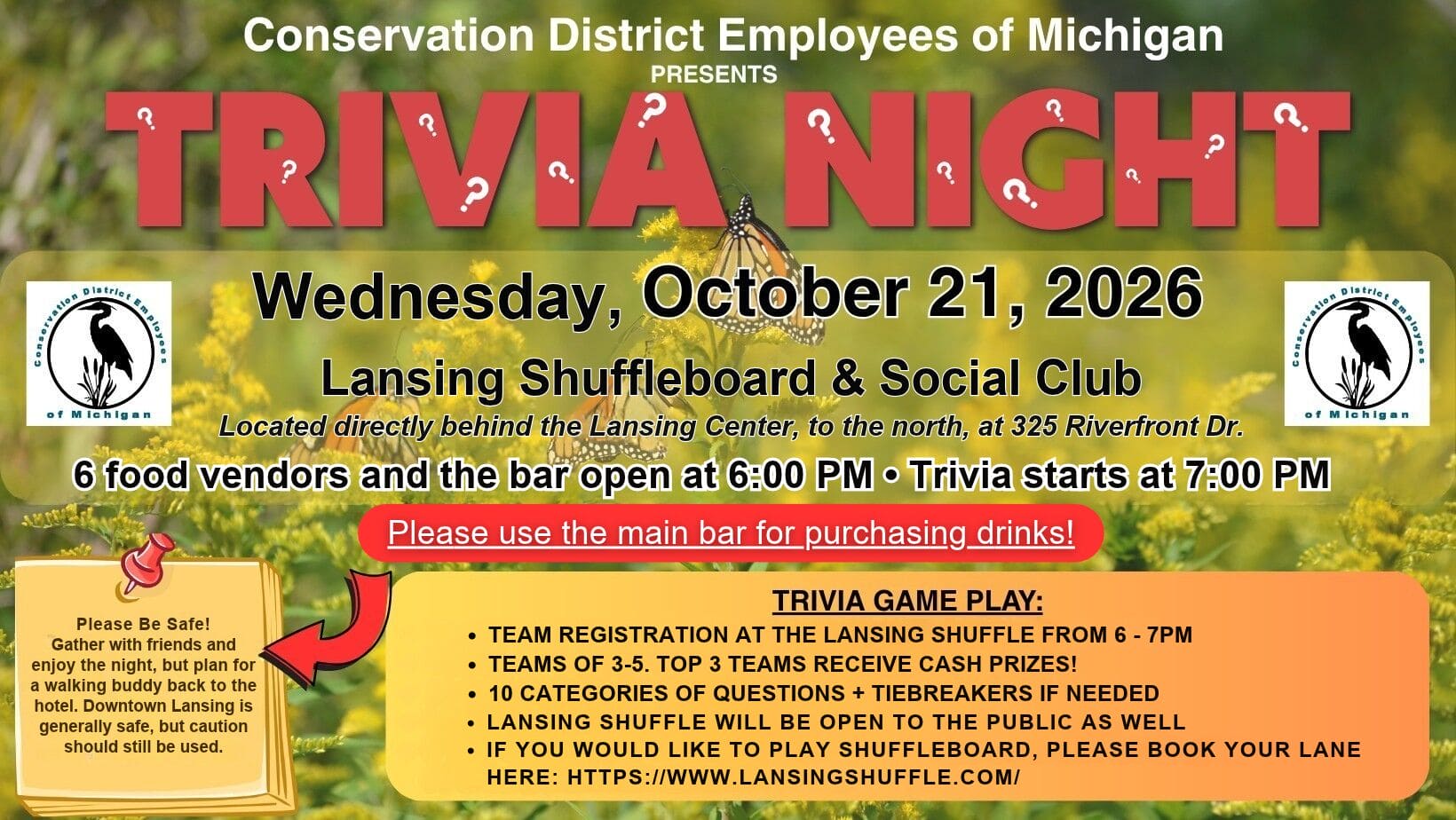
Trivia Night
October 22
Breakfast
PFAS and Michigan Agriculture
Session Description
This session will cover the basics of PFAS, how they contaminate agricultural land, the current research in crop and animal accumulation, and mitigation strategies. We will share how MSU Extension is currently working with farms across the state on education, risk assessment, no-cost sampling and even mitigation in situations where we have found PFAS contamination. We want to be a resource for field staff who have farmers with questions and concerns.
Digital Accessibility
Session Description
The Department of Justice requires all state and local government websites and mobile apps to conform to the Web Content Accessibility Guidelines (WCAG 2.1). There are a variety of tools available to ensure document quality and accessibility. Join us to look at some of the common ways you can build documents from the start with good accessibility built in, and some tools and resources to use when trying to make your old documents accessible. By the end of this session, you should have an understanding of document properties, accessibility tagging, color contrast, text for screen readers and tables.
Agrivoltaics in Practice: Different Farms. Different Solutions.
Session Description
No two farms face the same challenges, and no single solution fits every operation.
As farmers navigate increasing pressure from changing markets, rising production costs, generational transition, land access, environmental goals, and the need to strengthen long-term resilience, many are exploring innovative approaches that allow them to address multiple priorities at once. Agrivoltaics is emerging as one of those tools.
This session explores agrivoltaics through the lens of farmer decision-making, highlighting how producers are integrating solar with agriculture to solve a diverse range of challenges while maintaining their role as responsible stewards of the land. Through examples from across the Midwest, participants will examine how agrivoltaic systems are being used to support working lands, improve opportunities for the next generation of farmers, restore pollinator habitat, strengthen soil health, expand land access, diversify farm income, and create new pathways for long-term agricultural viability.
Rather than presenting agrivoltaics as a one-size-fits-all solution, this session emphasizes the importance of understanding the unique goals, values, and circumstances that influence each farmer's decisions. By recognizing that different farms are solving different problems, conservation professionals can better engage landowners, foster productive conversations, and identify opportunities where stewardship, agricultural production, and renewable energy can work together.
Attendees will leave with a broader understanding of the evolving role agrivoltaics can play within working landscapes, practical examples of farmer-led innovation, and new perspectives on supporting landowners through collaborative, locally informed conservation strategies.
What is 'natural'? Addressing landowner forest management expectations/perceptions.
Tiny Greens, Mighty Impact: Superfoods for your Windowsill
Session Description
Join Heather Hart of Wild Hart Acres for this engaging, hands-on workshop and discover how easy it is to grow nutrient-dense microgreens at home — using minimal space, water, and resources.
In just 50 minutes, you’ll learn the basics of microgreens from seed to harvest: optimal growing methods, harvest and storage techniques, nutritional power, and delicious ways to enjoy them. You will seed your own tray during the session and take home a complete starter kit containing everything needed to grow four varieties of microgreens right on your windowsill.
Perfect for beginners, this practical workshop highlights the conservation value of home-scale growing — including dramatic water savings, reduced food miles, and support for sustainable food systems. Taste fresh microgreens and leave inspired to bring this simple, eco-friendly skill to the residents in your community.
Ideal for Conservation District staff interested in offering meaningful, hands-on programming back home.
Dogs as Conservation (Detection) Stewards + Citizen Science
Session Description
Evidence suggests conservation detection dogs were first used in New Zealand as early as the 1890s. Although widespread adoption took another century, today these canine partnerships are among the most powerful and adaptable tools available to support endangered species protection and invasive species management.
With approximately 300 million scent receptors, dogs experience the world primarily through their noses. Research shows trained detection dogs can reliably recognize and discriminate among numerous target odors with remarkable accuracy, detecting scent at parts-per-trillion concentrations, often identifying biological material long before it becomes visible to people.
Today, conservation detection dogs locate invasive plants, agricultural pests, harmful algal blooms, wildlife scat, and rare species with exceptional speed and precision. Their value is consistent: higher detection rates, reduced labor, minimal environmental disturbance, and efficient coverage of difficult terrain. A complement to traditional surveys, canine teams enhance them by expanding search coverage, accelerating results, and improving accuracy. For Michigan's forests, freshwater systems, and agricultural landscapes, this means earlier detection, faster response, and lower long-term ecological and economic costs.
Despite their proven effectiveness, conservation detection dogs remain underutilized across much of the Midwest. This session explores the science behind conservation detection, highlights applications relevant to Michigan, and previews projects planned for 2026 and beyond. Attendees will gain a better understanding of how canine detection teams can strengthen invasive species response, biodiversity monitoring, ecological research, and long-term environmental resilience throughout the Great Lakes region.
The evidence is compelling. The opportunity is now. The question is how we choose to integrate this resource into Michigan’s conservation future.
Forest Bathing for Busy Professionals
Session Description
Could you use a breather about now? Come learn the techniques of the somatic practice of forest bathing for health and wellness for you and your landowners and community. Upon completion of this session, participants will:
- Learn the history and nomenclature of forest bathing as well as three physical and three mental health benefits gained from forest bathing.
- Learn to apply the eight steps of the standard sequence of forest bathing for your use and/or for guiding others.
- Learn three forest bathing invitations to use yourself and/or share with others during a guided experience.
Invasive Species in Michigan
Session Description
What’s going on with invasive species at the state level? Join the Michigan Invasive Species Program’s Katie Grzesiak (DNR) to get a refresher on the program and target species before diving in on updates. Learn about resources available to CDs, get sneak-peeks at projects coming down the pipe (and how to be involved), and get (and share!) tips on how to engage with the public and stakeholders. Terrestrial? Aquatic? Let’s cover it all!
Enhancing Human-Wildlife Coexistence Across Michigan
Session Description
Michigan’s landscape is changing biologically and socially. Wildlife populations are shifting, less people are hunting, and the public increasingly desires coexistence with wildlife. These and other factors create major challenges to traditional wildlife management, but underscore the need to implement contemporary and novel approaches. This presentation will explore how the Michigan DNR is adapting to these challenges to enhance human-wildlife coexistence, particularly through partnerships and contemporary conservation projects. This presentation will especially focus on current and potential partnerships with conservation districts across Michigan.
Environmental Education Roundtable
Session Description
If you work in conservation, you're already an educator, whether you're leading field trips, facilitating programs, restoring habitats, or inspiring your community to care for the natural world.
Join the MACD Education Committee for a lively and engaging roundtable where ideas are exchanged, connections are strengthened, and resources are shared.
Bring your favorite success stories and program highlights to:
- Exchange creative ideas with fellow conservation educators
- Discover new tools, resources, and strategies
- Learn from colleagues facing similar opportunities and challenges
- Build meaningful connections across Michigan's conservation community
Come ready to collaborate, share, and leave with fresh inspiration for your work. We look forward to seeing you there!
Doing More Without Doing More: Building Capacity Through Better Systems
Session Description
Staff capacity is limited; working harder isn't always the answer. Many organizations spend valuable time on repetitive tasks that could be streamlined with better tools and simple workflows.
Participants will identify bottlenecks, improve recurring processes, and create systems that are more efficient and easier to manage resulting in streamlined workflows. Attendees will leave with at least one process they can improve immediately, along with practical ideas for building capacity and getting hours back each month.
Succession Planning - Here Today, Gone Tomorrow
Session Description
Can your district survive the loss of your manager? Do you have a succession plan in place? Who has access?
A succession plan is the most important document you can provide to your board as a manager.
Since districts are vulnerable to turnover in management it is important to have one in place and review annually with the board of directors.
This session will go over a plan to get you started and get you motivated to create this for your district. Using the guidelines in the MACD district manual to get started,
Your secrets to success and what has worked for you is important for district survival.
Outreach to Underserved Communities
Technician Elevator Pitch and Competition
Session Description
How often do you find yourself explaining MAEAP, regenerative ag. and conservation districts? Do you wish you had a polished pitch at the ready? Join this workshop to craft your own elevator pitch. If you think you have a great pitch, compete against your fellow technicians to win the prize for best pitch!
Selling BMP's & Convincing Landowners to do the Right Thing
This session continues through 11:00 am in Banquet Rooms 1-6
Tree 4 Kids Program
Session Description
Dickinson CD has restarted an education program to provide every 4th grader in the county to receive an Eastern White Pine. Program is called Trees 4 Kids. Learn what they did and how you can start this program in your district.
Water Districts - Building Communities of Good Water Stewards
Session Description
Water Districts is a new concept for a region-based structure to directly address the major issues of data collection and modeling as part of large quantity water withdrawals across the State of Michigan. The current regulatory system has systemic process issues and lacks the scientific data and models required to reasonably evaluate potential aquifer and streamflow depletion in Site-Specific Reviews and manage the high-stakes water discussions in Water User Groups. The Water District concept specifically addresses these issues in a scientifically and legally defendable manner and provides a sound mechanism to build trust, communication, and stewardship at the grassroots and regulatory level.
Environmental Education Roundtable (cont.)
Session Description
If you work in conservation, you're already an educator, whether you're leading field trips, facilitating programs, restoring habitats, or inspiring your community to care for the natural world.
Join the MACD Education Committee for a lively and engaging roundtable where ideas are exchanged, connections are strengthened, and resources are shared.
Bring your favorite success stories and program highlights to:
- Exchange creative ideas with fellow conservation educators
- Discover new tools, resources, and strategies
- Learn from colleagues facing similar opportunities and challenges
- Build meaningful connections across Michigan's conservation community
Come ready to collaborate, share, and leave with fresh inspiration for your work. We look forward to seeing you there!
The Sterile Insect Technique: Past, Present and Future
Session Description
Join Dustin for this engaging session on the Sterile Insect Technique (SIT), its formation, and start from the atoms for peace initiatives. Learn about its spread across the world in various programs with IAEA support. Gain perspective on how the New World Screwworm was eradicated from North America in the 1970's and where that program stands now. During this session you will get a look at various types of SIT from classical sterilization to genetic modification and the Incompatible Insect Technique (IIT).
Lessons Learned from Regenerative Farming Practices at KBS LTAR
Session Description
Brook will reflect on the first 5 years of the Aspirational Cropping System at KBS LTAR, and introduce changes coming in the next 5 years. Observations and results will focus on challenges and successes of implementing regenerative practices as well as profitability, water quality, greenhouse gas emissions, soil health, and biodiversity.
Online and Data Security
Technician Elevator Pitch and Competition (cont.)
Session Description
How often do you find yourself explaining MAEAP, regenerative ag. and conservation districts? Do you wish you had a polished pitch at the ready? Join this workshop to craft your own elevator pitch. If you think you have a great pitch, compete against your fellow technicians to win the prize for best pitch!